Foreclosure / Quiet Title / Partition    Printer Friendly Version
(216) 443-8505 Fax: (216) 698-2990 10th Floor


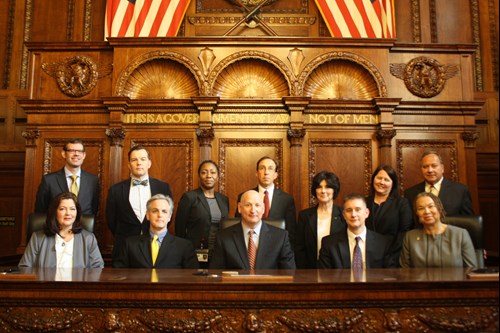
Chief Magistrate
Stephen M. Bucha III
Assistant Chief Magistrate
Kevin C. Augustyn

Magistrates
Paul H. Lucas
Monica Klein
Timothy M. Gauntner
Amy R. Cuthbert
Jim L. Jackson
Tracey S. Gonzalez
Gail D. Baker
John T. Dyke
Christopher E. Olsztyn
Carol Weiss
Kevin Hipley
Thomas J. Vozar

Foreclosure Mediation Program

Click Here for more information

  • All cases concerning foreclosure, quiet title and partition are heard by the Court’s magistrates.
  • Magistrate Department Phone:(216) 443-8505
  • Magistrate Department Fax:(216) 698-2990.
  • Please be aware that because of the rules of judicial conduct, the Magistrates may not be able to speak to you directly without all parties being present.
  • Magistrate Staff Phone:(216) 443-8505.
  • The staff will be able to answer most of the questions you may have but may not give you legal advice.
  • The Magistrates’ Department is located on the 6th floor of Courthouse Square, 310 W.Lakeside Ave. Cleveland, Ohio 44113.

Address

Frequently Asked Questions
I. Questions Frequently Asked by Self-Represented Litigants

How is a magistrate different from a judge?

In Cuyahoga County, a magistrate acts in place of the judge for most matters related to foreclosure, quiet title, and partition cases. Acts performed by a magistrate are subject to review by the judge assigned to the case. If you believe that a magistrate has ruled improperly, an objection to the magistrate’s decision must be filed within 14 days of the date that the decision was issued. If objections are not filed, the judge will adopt the decision of the magistrate. The magistrate’s decision becomes a court order when adopted by the judge.

I have received a summons which contains a document called a complaint. What happens next?

The summons and complaint are sent to notify you of the plaintiff’s claims and of what remedy the plaintiff seeks from the Court. In a foreclosure case, the plaintiff typically claims that you owe it a sum of money, that this debt is secured by a mortgage on your property, and that it would like the property sold to satisfy the debt. A written answer must be filed with the Clerk of Courts within 28 days from the date you receive the summons. If you do not file a written answer within the 28 days denying the allegations in the complaint, the Court will find that the allegations of the complaint are true and may, upon filing of an application for default judgment, grant the relief requested in the complaint.

I have received a notice indicating that a default hearing is set before a magistrate, what will happen at this hearing?

A default hearing is set when the party seeking foreclosure files a motion for default judgment. The motion is filed when at least one party to the case has not filed a timely answer. At the hearing, the magistrate will explain the foreclosure process. If the party seeking the foreclosure has made the proper allegations and has provided all necessary supporting evidence, the Magistrate will issue a decision allowing foreclosure. The property will be sold at sheriff’s sale.

Am I required to attend this default hearing?

No one but the party seeking the foreclosure must attend the hearing.

What happens after a decree of foreclosure is issued?

Once the Magistrate issues a decree of foreclosure and the judge adopts the decree, the party awarded the decree of foreclosure may order the property sold. If the party awarded the decree of foreclosure immediately orders the property sold at sheriff’s sale, the sale will be set on the sheriff’s sale calendar, the property will be appraised, and the sale will be advertised. The sale will occur approximately three to four months following the issuance of the Magistrate’s Decision.

Once the sheriff's sale occurs, can I still save my property?

Yes. You may redeem your property after sheriff’s sale by paying in full all of the liens on the property and all of the costs of the case within eight days of the date of sale. The Magistrates Department has sample motions to redeem. To complete a redemption, a motion to redeem must be prepared, all of the lien holders must be contacted for payoff amounts, the Sheriff’s Department and the Clerk of Court must be contacted to determine the costs of the case, and a journal entry must be prepared ordering the redemption and ordering the distribution of the funds to the various parties. A sample of this order is available from the Magistrate’s Department. The amount of Sheriff’s costs may be obtained by calling 216-443-6037. Clerk’s costs may be obtained by calling 216-443-7979.

The purchaser must be paid interest on his or her deposit at the rate of 8% per annum the Clerk of Court must be paid poundage at the rate of 2% of the first $10,000.00 of the total redemption amount and at the rate of 1% for the remainder of the total redemption amount.

When the necessary information has been obtained and the necessary documents prepared, the documents must be filed with the Clerk of Courts and submitted to the magistrate assigned to your case. After the magistrate has approved the submitted documents, a certified check in the verified redemption amount must be submitted to the magistrate. Once the magistrate confirms that the check is for the proper amount, the judge will sign the order of redemption. After, the judge signs the redemption entry, the check and a certified copy of the entry must be taken to the Cashiers Window in the Clerk of Court’s office to complete the redemption.

As you may have determined from this brief summary of the redemption process, it is a very complicated procedure involving numerous calculations. You are strongly advised to seek the assistance of a lawyer for your redemption.

The redemption process may take longer than the eight days granted by law. While you do not have an absolute right to additional time to redeem, you may seek additional time to redeem by filing a motion to stay confirmation. Whether you are granted additional time to redeem is in the sole discretion of the judge assigned to the case.

If I am unable to save my house from foreclosure, when do I have to move out of my house?

As part of the decree of foreclosure, the purchaser at sheriff’s sale is awarded a “writ of possession”. This allows the purchaser to evict the former owners of the home without the need to file a separate eviction case. The purchaser must notify the Sheriff’s Department that he or she desires to have the previous owner evicted. At this point a representative of the Sheriff’s Department will notify the previous owners of the house in question of the date by which they must vacate the premises, usually within two weeks of the notification.

If there is money left over after a sheriff's sale, who is entitled to this money?

       Once the plaintiff and any other parties who have claimed a lien on the property have been paid out of the sheriff’s sale proceeds, the party who owned the property at the time of sheriff’s sale is entitled to any remaining funds. In order to receive these funds, the owner of the property at the time of sheriff’s sale must file a motion to distribute balance of funds with the Clerk of Court. A sample motion to distribute balance of funds can be obtained by visiting the Magistrates’ Department.

What is a partition case?

A partition case is an action by which a co-owner requests division of property. In most cases physical division of the property is not possible. In such cases, the property will be sold at sheriff’s auction and the proceeds divided among the owners in proportion to their respective interest in the property.

What is a quiet title case?

A quiet title case is filed when a party claims an interest in property that is allegedly invalid and negatively effects the title of a parcel of property. Examples of such interests include encroachments by fences or buildings and unreleased but paid mortgages or judgment liens. If the party seeking to quiet title proves that the interest is invalid, the Court will declare the interest null and void.

II. Questions Frequently Asked by Sheriff Sale Purchasers

What is a sheriff’s Sale?

The sheriff’s sales are public auctions where property is sold to the highest bidder.

Where and when are the sheriff’s sale conducted?

The sheriff’s sales are conducted in the Justice Center Auditorium on the first floor of the Justice Center, 1200 Ontario Street, Cleveland, Ohio 44113. The sales take place every Monday at 10:00 a.m. unless Monday is a holiday in which case the sale will be conducted on Tuesday at 10:00 a.m.

Is there a minimum bid?

Yes. The minimum bid is an amount equal to 2/3 of the appraised value of the property, except in sales that result from real estate tax cases. In real estate tax cases, the minimum bid is equal to the taxes owed and court costs.

What are the terms of the sheriff’s sale?

The Sheriff will require you to make a 10% deposit or $10,000, which ever is less, on the day of the sale and require you to pay the full amount of your bid within 30 days of the date of the sale. If you fail to pay the full amount of your bid within thirty days from the date of sale you will be held in contempt of Court and may forfeit your deposit and be forced to pay a fine. In addition, if you fail to pay in full within eight days of the sheriff’s sale, interest will be charged on the balance at the rate of 10% per annum from the date of sale to the date the balance is paid.

How does a stay of confirmation alter the Sheriff’s payment schedule?

If the Court stays the confirmation of the sheriff’s sale, the purchaser is not required to abide by the initial payment schedule as detailed above. Rather, the day the stay is lifted is treated as the day of sale for the purposes of the payment schedule. Accordingly, the purchaser may pay the balance of the purchase price within eight days of the lifting of the stay to avoid paying interest and must pay the balance of the purchase price within 30 days of the lifting of the stay or face contempt charges.

What forms of payment does the Sheriff accept?

The Sheriff accepts as payment only in cash, by bank money order or by certified check.

How can I get a list of properties that are scheduled for Sheriff’s Sale?

A list properties scheduled for sheriff sale may be obtained at the Civil Division of the Sheriff’s Department, Justice Center, 2nd Floor, 1200 Ontario St, Cleveland, Ohio 44113. You may also obtain a listing online through the Sheriff's Office.

III. Questions Frequently Asked by Attorneys

What Local Rules govern foreclosure, partition and quiet title cases in Cuyahoga County?

Local Rules 24-27 govern foreclosure, partition and quiet title cases in Cuyahoga County.

Local Rule 24
Local Rule 25
Local Rule 26
Local Rule 27

If I file a foreclosure, quiet title, or partition case, what are some of the differences from a standard civil case?

The principal difference at the outset is the necessity to file (with the complaint) guaranteed evidence of the state of the record title of the property. This document is referred to as a Preliminary Judicial Report and will reflect the name of the record owner, a legal description of the parcel of land, and a listing of all interests in the property that appear of record. All parties with an interest in the property are necessary parties to the foreclosure case and must be named in the complaint.

What happens if I fail to provide a Preliminary Judicial Report?

The case may be dismissed after notice for such failure.

Where does the Court keep the foreclosure, partition, and quiet title files?

Case files are created and initially stored in the Clerk's Office, Civil Division, Located on the first floor of the Justice Center, North East Corner. This area is also referred to as "Pending Files."

If the file is not in “Pending Files" how can I locate it?

The first step in locating a file is to check the computer docket. The docket lists the case location. Here are some examples:

A)"Pend. Mag."-the file is on the 1st Floor with the Clerk of Court.
B)"Mag. Dept."-the file is on the 6th Floor in the Magistrate’s Department.
C)"Judge's File"-the file is with the assigned Judge. (check the Courtroom listing for each Judge.)
D)"Dead-45"-the file is located in Room 45, in the basement of the Old Courthouse located at One Lakeside Ave, Cleveland, Ohio 44113.

There are other possible locations, but the four places listed above hold most of the filed assigned to the magistrates.

How do I have a default hearing set before a Magistrate?

To have a default hearing set you should:
A) Prepare a motion for default judgement.
B) Obtain a final judicial report from the title company that prepared your preliminary judicial report.
C) Complete and sign a Certificate of Readiness.
D). Prepare an affidavit of military service regarding all defendants capable of serving in the military.
E) File and docket the motion, final judicial report, certificate of readiness, and military affidavit with the Clerk of Court. Walk these filings through to the Magistrates’ Department on the 10th Floor of the Justice Center. A hearing date will be set by the Magistrates once your motion and final judicial report are received.

How soon after filing the motion for default judgment will the default hearing be held?

Usually, a hearing will be scheduled approximately one month following the submission of the items detailed above.

What do I need to bring to the default hearing?

Any evidence necessary to support your claims and a proposed magistrate’s decision. Sample magistrate’s decisions are available at the Magistrates’ Department.

What happens to objections to magistrate's decisions?

Once an objection is filed, the Magistrate will wait ten days after the first objections for other objections or a reply to the objection. The Magistrate will then send the case file, magistrate's decision, objection to the magistrate's decision and reply to the objections to the assigned judge for ruling.

What action may the judge take regarding objections to a magistrate's decision?

Pursuant to civil Rule 53(D)(3)(b), upon consideration of the Objections, the Court may adopt, reject, or modify the Magistrate's Decision, hear any additional evidence, or recommit the matter to the Magistrate with instructions or hear the matter. The court may refuse to consider additional evidence proffered upon objections unless the objecting party demonstrates that with reasonable diligence the party could not have produced that evidence for the Magistrate's consideration.

Once a Judge adopts the Magistrate's Decision in a Foreclosure proceeding, how is the property set for a sheriff’s sale?

The party which is entitled to foreclosure may sign the Praecipe Book located at Window 17, Journal Department, Clerk's Office, on the first floor of the Justice Center. A deposit of $500.00 will be required to sign the Praecipe Book in Foreclosure cases. The signing of the Praecipe book will cause the Clerk to issue an Order of Sale to the Sheriff. The property will then be appraised, advertised and sold at a public auction in the Auditorium on the First Floor of the Justice Center. Local rule 27 requires the party ordering the sale to provide notice of the date, time and location of the sale to all parties in the case. If the sale occurs and the party ordering sale fails to provide this notice, the sale still may be valid since the Sheriff’s Department also provides notice. However, in these circumstances, the party who ordered sale will have to file a motion to confirm sale without Rule 27 notice. A sample of a motion to confirm without Rule 27 notice may be obtained from the Magistrate’s Department.

If I represent a junior lien holder, how will my client’s interests be addressed?

Because of the large volume of cases handled by the Magistrates’ Department, the Magistrates do not make findings as to all lien holders in the initial magistrate’s decision. Rather, findings are made regarding the first lien and the treasurer’s lien for taxes. All other liens that have been asserted are transferred to the proceeds of the sale. If there are funds remaining after payment of the first lien, the subsequent lienholders must file a motion for supplemental distribution. A sample of a motion for supplemental distribution may be obtained from the Magistrate’s Department. The Court will then make the necessary findings for the subsequent lienholders and distribute the funds accordingly.

Local Rules Applicable to Foreclosure, Partition, and Quiet Title Cases

LOCAL RULE 24 FORECLOSURE, QUIET TITLE AND
PARTITION ACTIONS

LOCAL RULE 25 PARTITION CASES

LOCAL RULE 26 RECEIVERSHIP

LOCAL RULE 27 SHERIFF'S SALES

Cuyahoga County (population 1,400,000) is situated along the shore of Lake Erie. It is the most populous of Ohio's 88 counties. Its largest city, and county seat, is Cleveland.

Cuyahoga County
Court of Common Pleas
1200 Ontario St.
Cleveland, Ohio 44113-1678

Cuyahoga County Common Pleas Court Homepage
Cuyahoga County Homepage

   Home         Judges         Jury Duty         Court Docket         Local Rules         Local Rule Amendments         Mental Health         Contact Us         News